Codebase structure
Paradigm
Status
This reflects MVC branch. Main branch follows no structure at all.
Sokora aims to follow the Model-View-Controller programming paradigm. If you like reading, you can check the Wikipedia page for MVC, but TL;DR:
- Views are what the user sees. They take data, present it, and offer buttons and stuff.
- Buttons and stuff call the controller, which is on a separate file. Controllers validate data and do business logic.
- Controllers that need to use the database or get data types refer to models, which are also separate on files.
- Models do database stuff and give their output back, simple enough.
- Controllers finish working and give data to the view for it to update.
Thus,
- Views can call controllers and controllers can call models, but never can a view call a model nor a model can call anything nor a controller can be inside of a view nor can everything be mixed up.
We’re not “purist” however, so solutions that are proven to be better will take precedence over those that are more compliant. MVC just defines the default shape and thinking method.
How this is actually structured
Features
Status
This reflects MVC branch. Features don’t exit by themselves, code is split across command handlers and other things.
There’s a features folder where we have (you guessed it!) Sokora’s features. Examples are mod/ban, math/graph, etc…
Features are written in a very specific way and are usable by both commands and Interkora (sometimes only the former, though). They do all the job except for the “rendering” of the resulting embed / HTTP resp / whatever. Within them, most of the code is feature logic. Database-related stuff is used but not implemented, all calls are done to wrappers over the database (like the already existing createCase, for example).
An example of a feature’s flow is this:
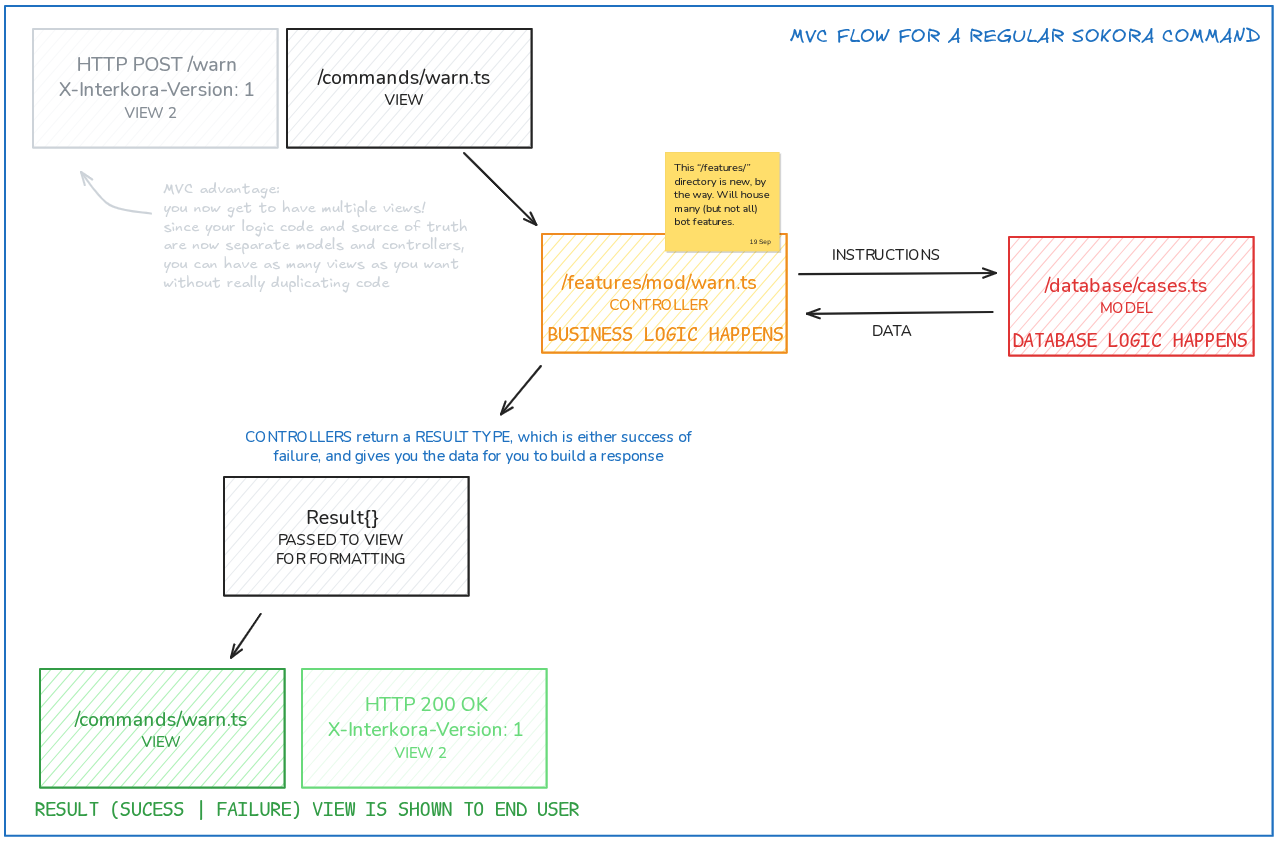
All features share a somewhat common shape (not final, might iterate):
interface Params {
  reason: string | null;
  guild: Guild;
  // ...
}

async function method(
  ...parameters: MethodParameters<Params, ModActionResult>
): Promise<FeatureOutput<ModActionResult>> {
  const [ok, fail, options] = parameters;
  const { reason, guild /* ... */ } = options;

}

export const warn = feature("mod/warn", method)
Let’s break this down:
Parameters: Self-describing. Ideally they should have JSDoc. Do not ask for an interaction or an event for interkorable features.
Method declaration: Declare an async function named method (name doesn’t really matter; it’s a convention) and spreading the MethodParameters<I, O> type (this is imported).
async function method(
  ...parameters: MethodParameters<Params, ModActionResult>
): Promise<FeatureOutput<ModActionResult>>
In MethodParameters<I, O>, I is input (your params interface) and O is output (what the feature returns if successful; define this freely, the example uses ModActionResult which is shared across moderation features).
The return type is a promise of FeatureOutput<O>, where O is the same as in MethodParameters. FeatureOutput is needed as the return type of all features.
You could pass a 2nd argument, as in FeatureOutput<S, F> where S is success output and F is failure output, however F’s default value can be spread into buildErrorEmbed so there’s little reason to override it.
From now on I’ll refer to FeatureOutput<…> as Result.
Getting what you need: You take parameters, then options, then you can work on the feature!
const [ok, fail, options] = parameters;
const { reason, guild /* ... */ } = options;

// below goes your actual logic
...parameters will give you three parameters, where your actual params interface is the last one. First two are ok and fail, there are helpers to build the Result without much writing: ok takes S from Result and fail takes F
Settings
Status
This reflects both branches.
There’s a whole page on our settings module (as in how it works), but for its structure there’s not much to know.
You have a database file called settings.ts which defines all settings. Settings are added in so-called setting declarations, which look like this:
export const defCategory = {
  setting_one: {
    type: "BOOLEAN",
    val: true,
    desc: "Whether setting one is enabled. Defaults to true.",
  },
  setting_two: {
    type: "OBJECT",
    iterable: false,
    desc: "Nested setting.",
    properties: {
      something: {
        type: "BOOL",
        val: false,
        desc: ":)",
      },
      something_two: {
        type: "INTEGER",
        desc: ":) 2",
        val: 60,
      },
    },
  },
} satisfies SettingDefinitionRecord["settings"];
Each category is defined as defName, and is an object typed SettingDefinitionRecord["settings"]. Individual properties are documented with JSDoc so it’s easy to get how things work.
If you create a new def, add it to the main object.
export const settingsDefinition = {
  leveling: {
    description: "Customize the behavior of the leveling system.",
    settings: defLeveling,
  },
  moderation: {
    description: "Change Sokora’s settings related to moderation.",
    settings: defModeration,
  },
  // add it here...
} as const;
Also specify if it’s a user category or a server category by adding its key to either of the arrays below settingsDefinition.